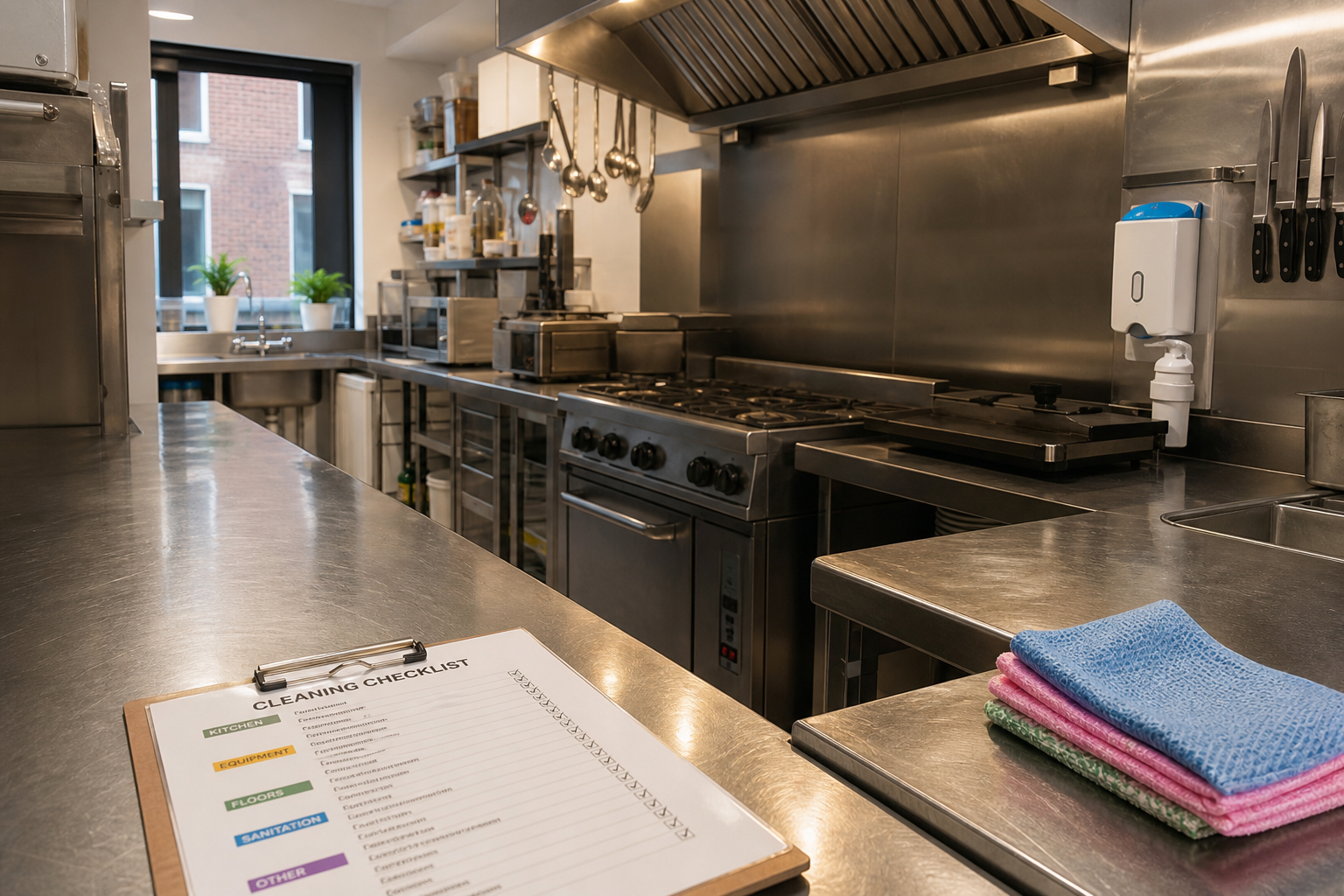
1. How to use this schedule
This schedule works best when it’s built into the rhythm of service rather than treated as an “extra job” at the end of the day.
- Assign by shift: split tasks into pre‑service, mid‑service, and close. Put names next to tasks so ownership is clear.
- Use planning averages: times below assume a small café kitchen and competent staff with basic tools (scrapers, food‑safe sanitiser, degreaser, microfibre cloths, mop, brushes).
- Record completion: keep a simple daily/weekly/monthly log with date, initials and any issues found (e.g., “fridge seal split—reported”). This supports your HACCP documentation.
- Review monthly: a quick monthly review catches recurring problems (grease build‑up, blocked drains, missed filter cleans) before they become compliance or safety issues.
Tip: print this as a one‑page checklist, laminate it, and keep a whiteboard marker attached. Transfer sign‑offs to your formal log at the end of each day or week.
2. Daily (every day) — quick, high‑impact tasks
Daily tasks focus on removing food residues, controlling cross‑contamination and keeping the kitchen visibly clean. In practice, these are the tasks that protect customers most and keep you inspection‑ready.
Pre‑service (15–25 minutes)
- Wipe and sanitise food contact surfaces and prep stations (5–10 mins): clear clutter first, then clean, then sanitise. Pay attention to board edges, under-lip surfaces and pass areas where hands and plates constantly touch. For common missed areas, see The critical areas you are forgetting to sanitise.
- Refill soap, sanitiser and paper towel dispensers (5 mins): if handwashing isn’t easy, it won’t happen consistently during a rush.
- Quick visual check of refrigeration temperatures and date labelling (5–10 mins): confirm fridges are running, doors are sealing, and foods are labelled and within use‑by guidance.
Mid‑service (5–15 minutes, as needed)
- Wipe spills immediately; clear benches and pass areas between orders (5–10 mins): prioritise anything that can spread (raw proteins, dairy, allergens, sauces). Keep a separate cloth system (e.g., colour‑coded) to reduce cross‑use errors.
- Empty front‑of‑house bins regularly to prevent odours (5 mins): especially where milk, food wrappers and coffee grounds build up quickly.
Close of day (30–60 minutes)
- Clean hobs, grills and fryers of surface residue; scrape and degrease (10–20 mins): while equipment is safely warm (not hot), remove carbon and grease before it hardens. If you need a safer routine for daily hob care, use Mastering the art of hob cleaning as a reference.
- Wash and sanitise all food contact equipment and utensils; air dry (15–30 mins): include knives, boards, GN pans, blender jugs, tongs, probe thermometer wipes, and the can opener (often forgotten). Air drying reduces re‑contamination from towels.
- Sweep and mop floors; spot clean drains (10–20 mins): clean from the cleanest zone to the dirtiest. Spot‑clean drain covers and the immediate area to reduce odour and pest attraction.
- Remove waste and recycling; clean bin lids and surrounds (5–10 mins): grease on bin lids transfers back to hands and handles.
- Record tasks in the daily log: note anything that couldn’t be completed (e.g., “oven too hot—scheduled for morning”).
3. Weekly — deeper cleaning to reduce build‑up
Weekly tasks remove grease and grime that daily cleaning will not reach—especially in small kitchens where equipment is close together and airflow carries grease onto nearby surfaces.
Plan weekly work on a quieter day, or split it into two sessions (e.g., 60–90 minutes twice a week) so it’s realistic with café staffing.
Weekly checklist (allocate 2–4 hours)
- Deep clean oven interiors and racks (60–90 mins): remove racks and trays, apply an appropriate degreaser, allow dwell time, then scrub and rinse thoroughly. Avoid harsh scraping that damages enamel and creates future sticking points. For a step‑by‑step method, use How to clean your oven professionally.
- Degrease extractor fan exterior surfaces and accessible filters (30–60 mins): wipe outer canopy surfaces and remove accessible filters (when safe). Grease on extractor edges drips onto cooklines and becomes a contamination and slip risk.
- Empty and clean under counters and behind equipment (30–60 mins): pull out smaller items (toaster ovens, microwaves, grinders) and clean the footprint underneath. Remove crumbs and food debris—this is critical for pest prevention.
- Descale kettles and coffee‑machine external parts; backflush where applicable (30–45 mins): follow manufacturer guidance for espresso machine backflushing and chemical use. Wipe steam wand areas carefully (milk residue is a high‑risk build‑up).
- Clean and reorganise dry food storage; check stock rotation (15–30 mins): wipe shelves, check open packaging is sealed, and remove out‑of‑date items. Keep allergens separated and clearly labelled.
Grease management is often the weekly task that gets skipped first—until it becomes a bigger job. If you need a practical approach to stubborn grease across stainless steel and tiles, see How to remove grease from kitchen surfaces and appliances.
4. Monthly and quarterly — scheduled deep cleans
Monthly and quarterly work is where many cafés fall behind: the tasks take longer, require partial downtime, or need more than one pair of hands. The payoff is big—less grease accumulation, fewer odours, fewer breakdowns, and clearer evidence of control measures.
Monthly (half‑day: 3–5 hours)
- Full extractor hood clean (interior surfaces and housing) where accessible (60–120 mins): clean reachable interior surfaces once the area is cool and safe. Use appropriate degreasing products and rinse/wipe thoroughly so residue does not drip later.
- Fridge and freezer full defrost and deep clean; check seals (60–90 mins): remove all stock, store safely, clean shelves and corners, and check door seals for splits or gaps. If you want a structured process, use How to clean your fridge.
- Deep clean floor drains and grease traps (30–60 mins): remove covers, clean build‑up, and flush appropriately. Record any persistent odour or slow drainage as a maintenance issue—not just “a cleaning problem”.
- Clean behind and under large equipment (60–90 mins): where safe to move, pull out units and clean the wall/floor behind. If equipment is fixed, clean accessible edges and schedule professional support if required.
Quarterly (full day: 4–8 hours or professional visit)
- Professional hood and duct clean (if contract or required by local authority): internal ductwork is often beyond safe in‑house reach. Frequency depends on usage, cooking type and any insurance/manufacturer requirements—document what you do and why.
- Boil‑out of fryers and service on high‑use cooking equipment: schedule during a closed period to avoid cutting corners. Record servicing and any parts replaced.
- Professional descaling/service for espresso machines and dishwashers if used heavily: scale and detergent build‑up reduce performance and hygiene. Follow your machine’s manual and service guidance.
- Review and refresh HACCP cleaning records and staff training: check that logs match reality, that chemicals are correctly labelled, and that new starters know the routine.
5. Equipment cleaning frequency & realistic time estimates
Different equipment has different “dirt rhythms”. A schedule works when it respects how the café operates (peak times, warm‑up and cool‑down periods) and the level of use. Use the estimates below for staffing and rota planning.
Extractor hood & filters
- Daily: wipe exterior and remove loose grease (5–10 mins)
- Weekly: remove and soak metal baffle filters in degreaser (20–40 mins)
- Monthly/Quarterly: deeper interior clean or professional duct service depending on usage (60–240 mins)
Operational tip: have a spare filter set if possible. That way, you can swap filters quickly and soak the dirty set without extending close‑down time.
Oven, grill and hob
- Daily: scrape and wipe immediately after service (10–20 mins)
- Weekly: remove racks and deep‑clean interior (60–90 mins)
- Quarterly: check seals and consider professional servicing (time varies)
Practical note: carbon build‑up becomes harder and more time‑consuming if left. A consistent daily scrape cuts weekly deep‑clean time significantly.
Fridges and freezers
- Daily: spot clean spills and check temperatures (5–10 mins)
- Weekly: wipe shelves and door seals; check stock rotation (20–40 mins)
- Monthly/Quarterly: full empty, defrost and deep clean if frost builds up (60–90 mins)
Control point: a damaged seal isn’t just an efficiency issue—it can cause temperature drift and condensation that encourages mould and odours. Record it and raise maintenance.
Dishwasher
- Daily: clean filters and run rinse cycles (5–15 mins)
- Weekly: descale and clean spray arms (20–30 mins)
- Quarterly: professional service as needed
Process tip: set a fixed “dishwasher shutdown routine” (filters out, inspect wash arms, leave door ajar to dry). Consistency prevents the slow build‑up that leads to poor wash results.
Coffee machine (commercial)
- Daily: backflush and clean group heads; wipe steam wand after each use (10–15 mins)
- Weekly: remove and soak portafilters and baskets; deep clean water lines where possible (20–40 mins)
- Quarterly: professional service recommended for busy outlets
Food safety angle: milk residue on steam wands and cloths is a common weak point—keep dedicated, frequently changed cloths and a clear wipe‑after‑every‑use rule.
Fryer
- Daily: filter oil and remove large debris; wipe surfaces (10–20 mins)
- Weekly: surface degrease and clean baskets (30–60 mins)
- Monthly/Quarterly: complete boil‑out and inspection (60–180 mins)
Safety note: allow cooling and follow manufacturer guidance. Hot oil and water/chemical mixing is a serious hazard—never rush fryer cleaning to “save time”.
6. Compliance, records and staff responsibilities
Inspections are easier when you can show a clear system: what you clean, how often, who does it, and what you do when something goes wrong. Your logs don’t need to be complicated—but they should be consistent.
- Keep dated logs: daily, weekly and monthly sheets with task ticks and staff initials/signatures.
- Record corrective actions: e.g., “found debris behind fridge—cleaned and added to weekly pull‑out list”.
- Attach evidence where useful: photos after a quarterly deep clean, or invoices for professional ductwork and servicing.
- Assign ownership per shift: the close‑down lead signs off, but each station owner completes their own tasks.
- Train for consistency: show new staff the “why” (cross‑contamination, allergen control, pest prevention), not just the steps.
If you want a structured way to formalise these routines into something auditable, use Creating your own cleaning standards as a starting point.
7. Practical tips to save time without cutting corners
- Split deep tasks across quieter days: for example, extractor filters on Tuesday, behind equipment on Thursday, storage on Sunday.
- Use “dwell time” properly: apply degreaser, then do another task while it works. This reduces scrubbing time and improves results.
- Keep a tight chemical kit: one food‑safe sanitiser, one degreaser, one descaler (as appropriate) plus labelled spray bottles and clean cloths. Too many products causes confusion and mistakes.
- Standardise cloths and brushes: separate tools for raw prep vs general surfaces; store them hygienically so they dry between uses.
- Soak removable parts overnight: racks, baffle filters, and fryer baskets (where appropriate and safe). This shifts labour from scrubbing to rinsing and inspection.
- Plan downtime: pick a monthly half‑day when you can safely empty fridges and move equipment without service pressure.
8. Café kitchen cleaning checklist (brief)
Use this as a quick “at a glance” log structure. Many cafés post this near the handwash sink or inside a cupboard door.
- Daily log: surfaces sanitised, fridge temps checked, dishwasher checks, bins emptied/area wiped, floors cleaned, close‑down signed off.
- Weekly log: oven deep clean, extractor filters soaked/cleaned, behind equipment cleaned, coffee machine deep clean/backflush routine verified.
- Monthly log: full fridge/freezer clean and seal check, extractor hood interior clean (accessible parts), drains/grease trap deep clean, under/behind large equipment.
- Quarterly: professional services as needed (ductwork/fryer/espresso), refresh staff training, review HACCP records and correct gaps.
Contact the team for practical advice if you’d like help turning this into a tailored plan for your layout and equipment, or arranging periodic deep cleans: Go Cleaners London.