
Kingsbury / NW9
Carpet Cleaning Kingsbury: A Clear Plan for Soil, Fibre and Access
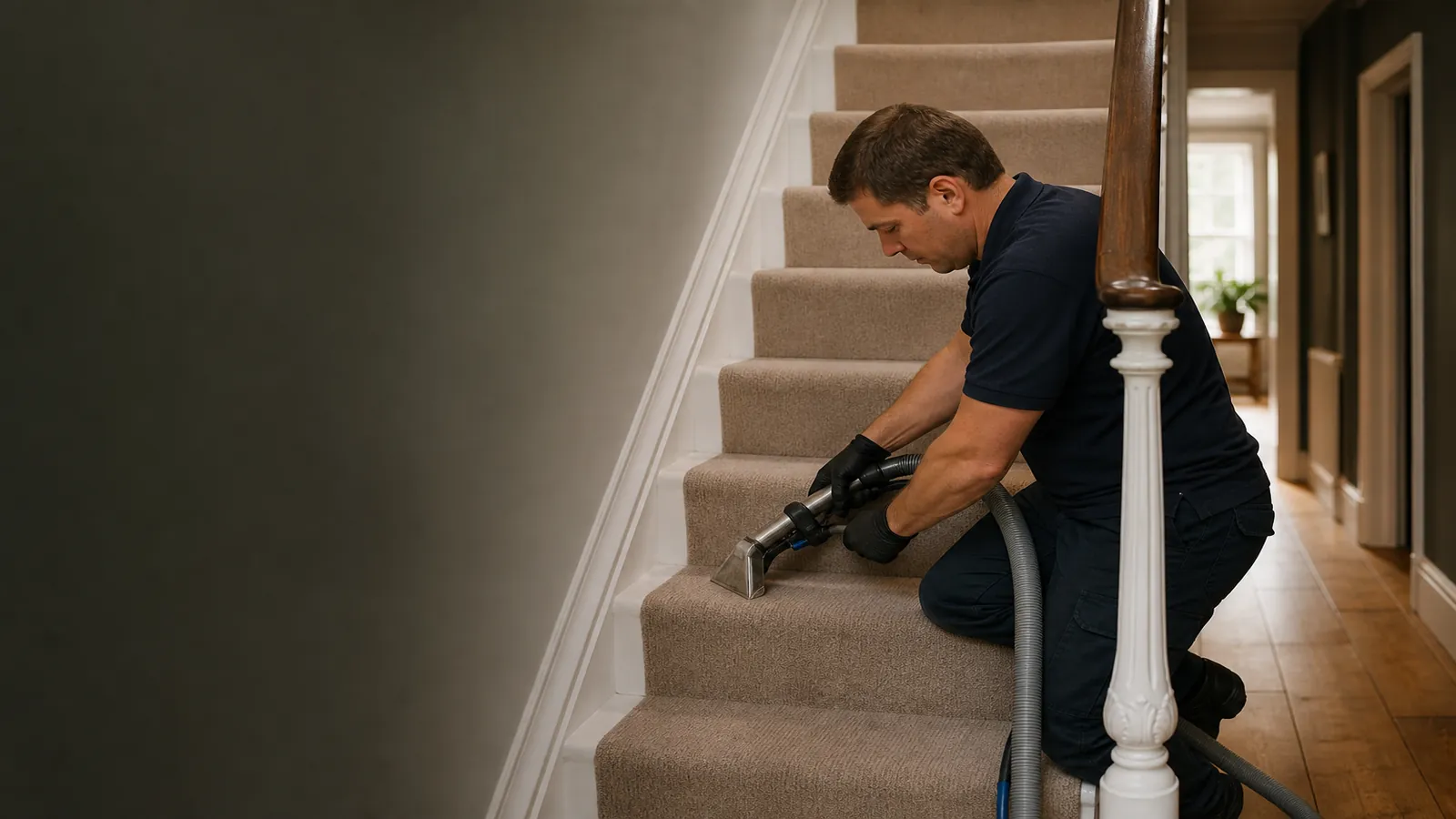
- Treads counted separately from adjoining rooms
- Nosings and turns inspected for wear before cleaning
- Edge soil removed without forcing moisture into gaps
- Safe access maintained while each section is treated
SERVICE TEAMS / THE AGREED WORK
Four reasons a carpet may change across the view

Pile running in another direction
Fibres reflect light differently as their orientation changes. Gentle grooming and movement around the room help reveal this effect before the cleaner decides that a dark area needs more chemistry.

Compression through a traffic lane
Cleaning can remove soil and improve presentation, but repeatedly crushed pile may not stand like protected fibre. The remaining texture is documented rather than disguised as a wet patch.

Fading near a source of light
Missing colour cannot be rinsed back. Soil removal may increase the visible contrast with an exposed area, which is why pre-clean notes and consistent photographs matter.

A fixed mark across changing shading
If discolouration remains in place while pile reflection alters around it, targeted testing may be justified. Treatment still respects fibre and dye response, with no guaranteed removal.
Optical assessment prevents over-treatment; it does not excuse incomplete cleaning. The carpet still receives full preparation and the agreed rinse wherever recoverable contamination is present. Customers can make the final review more reliable by allowing ordinary room light where practical and by avoiding a single spotlight aimed only at the darkest view. If a band changes as people walk around it, that behaviour is recorded. If it remains fixed, the technician considers soil, dye and wear separately before proposing another attempt. Furniture placement can complicate the comparison. Carpet under a cabinet may retain taller pile and stronger colour while also holding a sharp pressure line at its edge. The sheltered patch is therefore a reference, not a promised final shade for the exposed room. After extraction, the cleaner allows grooming to settle before describing the contrast and notes which direction produces the darkest view. Customers are advised not to scrub a directional band after the visit. Such action can distort fibres and add product residue without changing the underlying way that light reflects from the pile.
Much of the damaging load begins as dry material
Carpet can hold a surprising quantity of fine particulate matter without looking dramatically stained. Tracked grit travels from entrances into circulation routes, settles beneath the visible pile and moves against fibres under foot pressure. The Kingsbury page concentrates on dry-soil control because removing that load early improves both the cleaning process and the maintenance conversation.
The assessment follows the route of use rather than assuming uniform dirt. An entrance may contain larger debris, a corridor can show compacted fine dust, and protected areas provide a comparison for colour and texture. None of these patterns is claimed to be universal in Kingsbury; the cleaner confirms them in the property and records wear that will not disappear with extraction.
Vacuum preparation is performed with suitable overlap, attention to pile direction and narrower tools at boundaries. A quick pass cannot be rescued simply by spraying more solution afterwards. If loose particles remain, moisture may turn them into a difficult suspension and place needless demand on the rinse and recovery stage.
Once the dry fraction has been reduced, bonded contamination can be addressed more precisely. Pre-treatment is chosen for the carpet and given time to act. Measured agitation helps release films from fibres, while extraction carries them away. This order makes each stage accountable instead of asking one powerful machine pass to perform every function.
Prevention after the appointment is modest but worthwhile: effective entrance control, vacuuming suited to actual footfall and prompt blotting of spills. General housekeeping can be coordinated through domestic cleaning, but the frequency and equipment used on the carpet should remain appropriate to its pile and condition.
SERVICE SCOPE / READ BEFORE BOOKING
The components of a maintenance reset
Included in this brief
- Review of previous cleaning attempts, current texture and visible residue clues
- Dry particulate removal across open areas, edges and established traffic routes
- Proportionate pre-conditioning, agitation and extraction for the identified carpet
- Post-clean review with sensible guidance for drying and ongoing vacuum care
Outside this cleaning brief
- Promises to reverse pile wear, bleaching, fading or damaged construction
- Application of protective products unless specifically assessed and agreed
- Cleaning of curtains, seating or beds as unlisted additions

PRICING / CLEAR STARTING POINTS
The quotation defines the affected layers it can address
Provide room size, stairs, fibre, access, incident history and approximate affected area. Current guidance is maintained on the prices page. The Kingsbury quotation covers declared carpet work and does not quietly price in structural investigation that the service cannot perform.
01
Single room
From £15 / room
Compact bedroom or study
02
Double room
From £15 / room
Standard double bedroom
03
Lounge
From £15 / room
Living room with clear equipment access
04
Stairs
Quotation
Standard flight, subject to construction
05
Hallway
Quotation
Reachable hall or landing
06
Whole property
Quotation
Measured rooms and fibre types
Prices are guide prices.
Final quotation depends on the property, condition and requirements.
Why colour is weak evidence
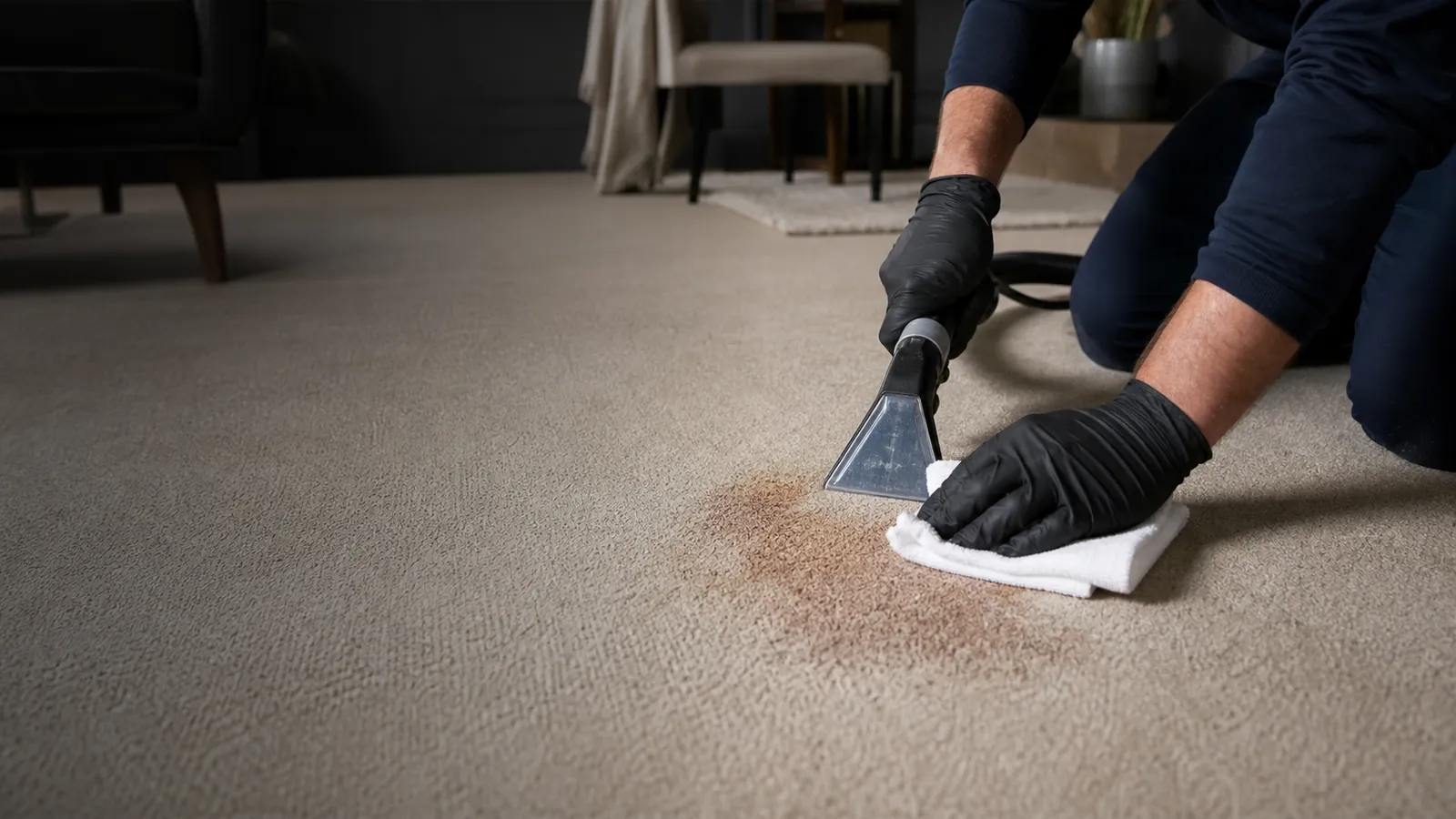
Brown may describe tea, tracked soil, oxidation or a reaction to an earlier cleaner; red may come from several unrelated dyes. Selecting a remover from colour alone is therefore unreliable. Context, fibre and a controlled response test provide a safer basis.
Odour and visible staining are not identical
A mark can fade while an odour source remains deeper, or an odour may have no obvious coloured boundary. Carpet cleaning addresses the agreed textile treatment, but it cannot promise remediation of concealed structural contamination that has not been inspected.
Blotting protects more options than rubbing
Pressure with an absorbent towel lifts liquid vertically. Rubbing drives it sideways, distorts pile and may transfer dye. Work from the edge towards the centre, change the towel surface as it loads and stop before adding improvised chemistry.
Beds affected by a separate incident
A mattress has absorbent internal layers and different drying constraints. When it is part of the incident, request mattress cleaning separately, state what happened and avoid presenting carpet extraction as a complete answer for both items.
PROCESS / FOUR DECISIONS
Create a baseline that future care can use
01
Record today’s pattern
The operative maps traffic, protected pile, spots and existing damage. Previous intervals and products provide context but do not dictate the method chosen for the current textile.
02
Remove dry and bonded loads in order
Vacuum extraction reduces grit; compatible pre-treatment and agitation release films. Extraction rinses the pile and uses recovery strokes to avoid leaving a sticky maintenance problem behind.
03
Define the honest clean baseline
After grooming, the cleaner marks any fading, shading, dents or wear that remains. The customer can distinguish these stable features from new soil during later observation.
04
Agree what to watch, not a sales date
Aftercare covers equipment suitability, higher-use zones, spill blotting and drying. A future booking is suggested only when condition evidence supports it, not as an automatic conclusion.
VISIT / HANDOVER
Make the room easier to assess


Remove small valuables and fragile objects, but discuss heavy or connected furniture rather than moving it unsafely. Tell us about previous spot products and access constraints. Routine housekeeping is a separate service described under domestic cleaning.
MAP / COVERAGE CONTEXT
Plan the route into the Kingsbury property.
Coverage context for Kingsbury. This map does not represent a staffed local office.
EXPLORE / NEXT
Related services in Kingsbury
EXPLORE / NEXT
Nearby areas for carpet cleaning
Possible causes include product residue, an unresolved spill or contamination returning from depth. The condition must be inspected; adding stronger detergent without evidence can make re-soiling worse.
Kingsbury questions about traffic lanes and residue
Why does a cleaned carpet sometimes become sticky?
Temperature is only one variable. Fibre, dye, chemistry, preparation and recovery matter. The suitable range is chosen for the carpet rather than maximised for a dramatic claim.
Will a greasy lane need very hot water?
Yes. Flattened or abraded fibre reflects light differently. The operative compares directions and protected pile, explaining where the remaining colour is no longer recoverable soil.
Can wear look like dirt after cleaning?
That should never be assumed. A bed has different materials and contact requirements. Use mattress cleaning for its independent assessment and method.
Can mattress cleaning use the same degreasing product?
No. It describes service coverage and practical local context, not a staffed branch.
Map the Kingsbury footfall before requesting a slot
Send carpet dimensions, stairs, fibre, entrance and turning routes, specific spill records, furniture limits and exact access times. Explain how the floor must be used afterwards. These facts support an efficient sequence and transparent handover without turning a busy carpet into an excuse for excessive chemistry or a false drying guarantee.